Planning a wedding brings a lot of excitement, but dealing with the heavy paperwork can turn into a real headache. Many couples in the pink city now skip big, expensive celebrations entirely. They don’t want the massive bank bills or the chaotic planning. Instead, they choose a straightforward Court Marriage in Jaipur. It keeps your money safe, avoids endless family drama, and gives you a genuine government document right away. But you need to know how the legal track actually works before you visit any office.
If you sort your documents properly from day one, the whole system feels incredibly easy. You won’t have to keep running to different desks or deal with weird legal jargon. Let’s look closely at the exact steps, the actual waiting timelines, and the real papers you need to grab your certificate without getting stuck.
Step 1: Submitting Your Intent Notice
The very first legal move for a Court Marriage in Jaipur is formally telling the local registrar about your plans. Under the Special Marriage Act, you do this by filling out a form called the Notice of Intended Marriage.
- Pick the right office: You cannot just go to any random office counter. You must submit this application to the Marriage Officer in the specific district where either the groom or bride has stayed for a minimum of 30 days.
- Fill your details: Both partners must write down their full names, home addresses, and exact birth dates. You’ll attach your recent passport photos to this sheet and sign it together.
- Get the fee receipt: Pay the small government processing fee at the office cash counter. Keep that paper receipt safe because it holds your main application tracking number.
Once this initial form goes into the official records, your official legal wedding timeline starts.
Step 2: The Mandatory 30-Day Waiting Frame
After the office accepts your application files, a quiet waiting phase begins. For a direct, civil Court Marriage in Jaipur, this 30-day window is a strict rule. No one can bypass it.
- Pasting the paper: The Marriage Officer takes a copy of your signed notice and glues it onto the public board outside their room.
- Public viewing time: The law leaves it on display for 30 consecutive days. This allows anyone to check it and raise an official objection if the union breaks core marriage laws.
- What counts as a real objection? It must be a serious legal issue. For example, if a partner is secretly married already or lied about their real age. Personal family arguments or caste disagreements don’t matter to the registrar at all.
If those 30 days pass completely clear and nobody files a valid legal complaint, the clerk closes the window and approves your file for the final step.
Step 3: Getting Your Original Documents Organized
While you wait out those 30 days, get your folder ready. If you want a smooth Court Marriage in Jaipur, your paperwork must be completely perfect. Don’t show up with torn or missing sheets.
- Age Proof IDs: The boy must be at least 21, and the girl must be 18 or older. Bring your 10th-class marksheet, a birth paper, or a valid passport to prove this.
- Local Address Proofs: Carry your Address IDs (like voter cards or a registered rent agreement) to show you live in the locality.
- Notarized Affidavits: You both need separate affidavits stamped by a local notary. The text must declare that you’re currently single, your ages are real, and you aren’t close blood relatives.
- Photos: Keep at least 6 fresh passport-sized colour photos of both the bride and groom in your bag.
Step 4: Final Appearance and Witness Signatures
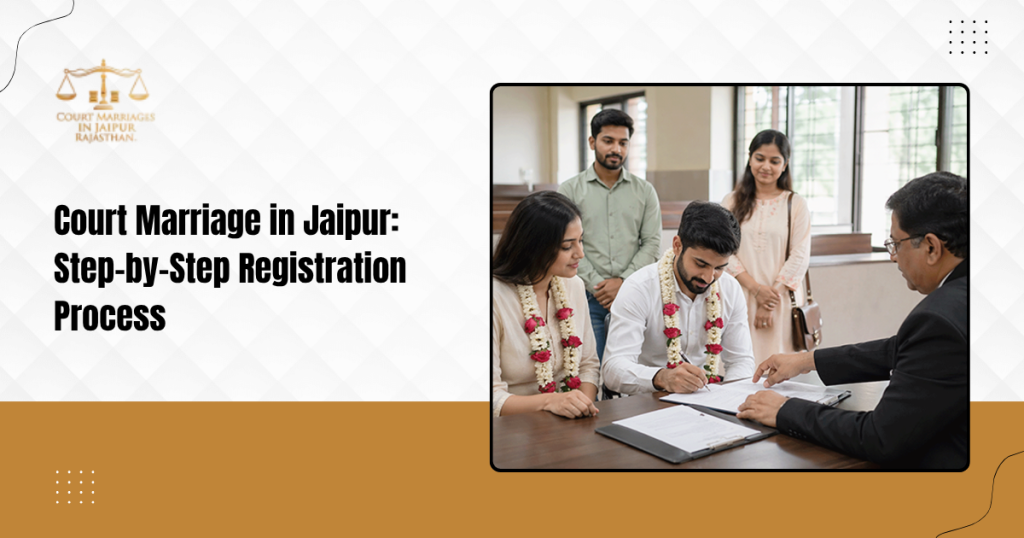
Once the 30-day notice period ends, you can book your final appointment slot. Both partners must physically show up at the registrar’s office to finish their Court Marriage in Jaipur.
- Bring Three Witnesses: You can’t do this alone. You must bring three adult witnesses with you on that day. They can be your close friends, coworkers, or neighbours.
- Witness Papers: Every single witness must carry their original government ID cards and PAN card. Bring two photocopies and a couple of passport photos for them too.
- Signing the Registry: The Marriage Officer checks everyone’s original IDs. Then, both partners and all three witnesses sign the official marriage registry book.
Step 5: Collecting the Final Certificate
This is the last part of the process. Once the signatures are recorded in the registry book, the legal side is completely done.
- The Government Seal: The Marriage Officer signs your main certificate and stamps it with the heavy government seal.
- Absolute Legal Proof: This paper goes directly into the local Marriage Certificate Book. It acts as 100% legal proof of your wedding anywhere in India and across international borders.
- Digital Downloads: You can also log into the state portal later on to download a digital version whenever you need a quick copy.
Final Thoughts
If you follow the proper steps, a Court Marriage in Jaipur is a very secure and smooth process. Don’t look for shortcuts, don’t skip the age checks, and make sure the names on your paperwork match your school certificates perfectly. Getting your three witnesses ready ahead of time saves you from a lot of headaches on the final morning. At Court Marriages Jaipur Rajasthan, we help couples understand the process and prepare the required documents correctly. If you want a stress-free and legally compliant experience without dealing with confusing office procedures, you can rely on our experienced team for assistance.
Frequently Asked Questions
1. Can different religion couples do a Court Marriage in Jaipur?
Yes, absolutely. The Special Marriage Act was built exactly for this. Interfaith and inter-caste couples can marry legally without changing their faith or performing any religious rituals.
2. Can we shorten the 30-day notice for a Court Marriage in Jaipur?
No, if you’re marrying directly through the civil court process, the 30-day notice is a strict legal rule. You cannot reduce this waiting time.
3. Do our parents have to come as witnesses for a Court Marriage in Jaipur?
No, they don’t. The law just says you need three adults with valid government IDs. It can be any friend, coworker, or neighbour you trust.
4. Is there a fast-track option available for a Court Marriage in Jaipur?
No. The civil route has a strict 30-day notice rule. For urgent cases, couples get a religious wedding first and then use the government’s fast-track Tatkal registration scheme.
5. Can we change our chosen wedding date after filing the notice?
Yes. Once your 30-day notice clears, you have a three-month window to appear before the officer and finish the process before the notice expires.
For daily updates and important legal tips, follow us on Facebook and Instagram.